

Studying Sunset Boulevard for VCE English? This complete guide covers Billy Wilder’s key ideas, characters, film techniques, symbols, evidence and VCAA-style essay prompts.
Billy Wilder’s Sunset Boulevard can seem fairly straightforward when you first watch it. A struggling writer meets a forgotten movie star, becomes financially dependent on her, tries to escape and ends up dead in her swimming pool.
But that plot is really the starting point.
Sunset Boulevard is a film about people who build their identities around stories that are no longer true. Norma Desmond tells herself that she is still a star. Joe Gillis tells himself that he can accept Norma’s money without losing his independence. Max tells himself that protecting Norma from reality is an act of love. Hollywood itself sells dreams while quietly discarding the people who no longer fit them.
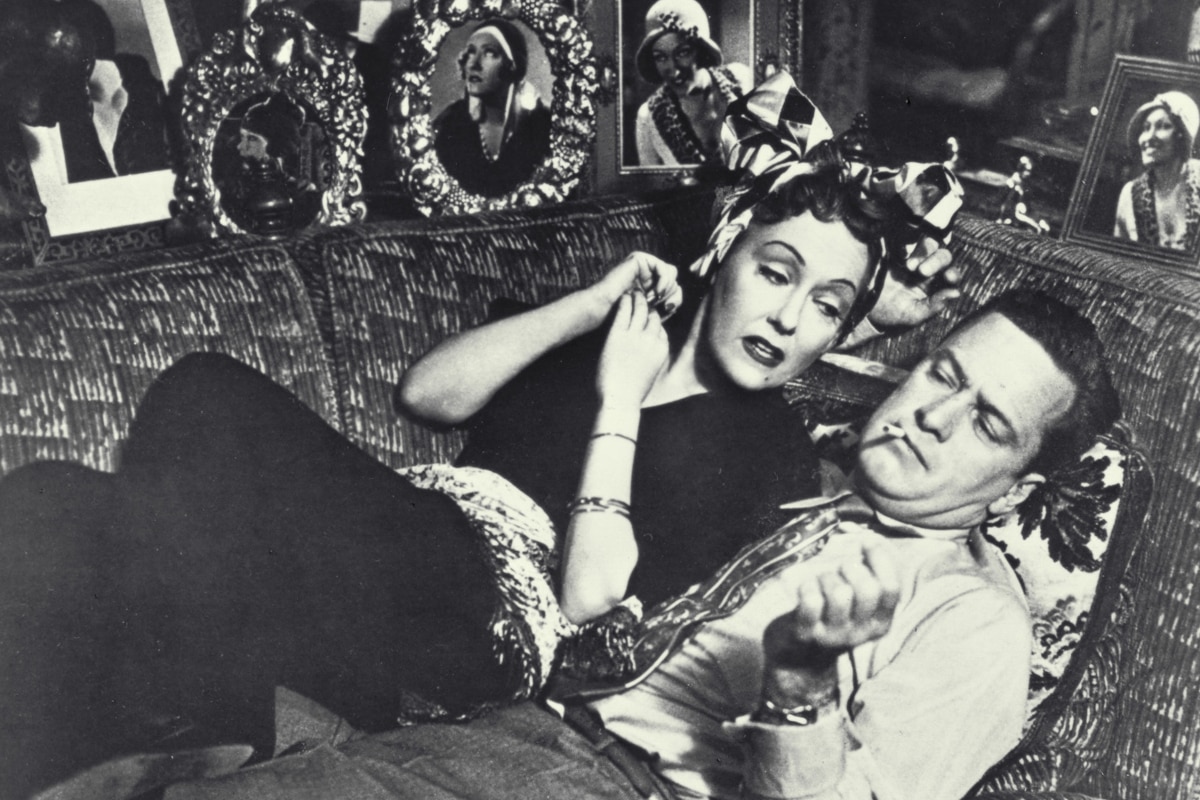
Wilder repeatedly presents Norma as both a genuine screen presence and a woman trapped by the identity Hollywood created for her.
Sunset Boulevard: the basics
Sunset Boulevard was released in 1950 and directed by Billy Wilder. Wilder wrote the screenplay with Charles Brackett and D. M. Marshman Jr. William Holden plays struggling screenwriter Joe Gillis, Gloria Swanson plays former silent-film star Norma Desmond, Erich von Stroheim plays her butler Max von Mayerling and Nancy Olson plays aspiring writer Betty Schaefer. Cinematographer John F. Seitz created the film’s striking black-and-white images, while Franz Waxman composed its score.
The film was nominated for 11 Academy Awards and won three: writing, black-and-white art direction and musical score.
It is usually described as film noir, but that label only tells part of the story. Wilder combines noir with gothic horror, melodrama, satire and a film about filmmaking itself. The result is a movie that can be funny, disturbing and genuinely tragic within the same scene. The film is both a dark examination of the Hollywood “dream factory” and a kind of gothic farewell to an earlier era of cinema.
What VCE students actually need to do
The current VCE English study design asks students to analyse the ideas, concerns and values of a text through its structures and language features. For film, VCAA specifically encourages students to analyse features such as camera work, mise-en-scène and sound. It also emphasises inferential viewing: looking beneath what literally happens in a scene to consider its social, historical and cultural implications.
So instead of writing:
Norma becomes increasingly delusional because she wants to be famous again.
A stronger line of analysis would be:
Wilder repeatedly frames Norma inside the dark, crowded interiors of her mansion, visually trapping her within the remnants of her former fame. Her delusion is therefore not presented as an isolated personal failure; it has grown out of an identity built almost entirely around being watched.
The second version discusses the idea, the film technique and Wilder’s broader point.
Plot overview
The film begins at the end.
Police arrive at a mansion on Sunset Boulevard, where the body of screenwriter Joe Gillis is floating in a swimming pool. Joe then begins narrating the events that led to his own death.
Six months earlier, Joe is a struggling Hollywood screenwriter who cannot sell his latest script and cannot keep up with payments on his car. While escaping the men trying to repossess it, he drives into the neglected mansion of Norma Desmond.
Norma was once one of Hollywood’s biggest silent-film stars. She now lives almost completely removed from the outside world with her butler Max. Norma believes she is preparing for a return to the screen and hires Joe to edit the enormous screenplay she has written about Salomé.
Joe initially stays because he needs the money. Gradually, however, Norma takes control of more of his life. She pays his debts, buys his clothes, moves him deeper into the house and begins treating him as her romantic partner.
Joe knows the situation is unhealthy, but he also enjoys its comforts.
Meanwhile, he begins secretly writing with Betty Schaefer, a young Paramount script reader who believes Joe is capable of better work. Their relationship offers him a possible way back into both genuine creative work and ordinary life.
Norma eventually discovers the relationship and contacts Betty. Joe responds by bringing Betty to the mansion and deliberately showing her what he has become. After sending Betty away, he finally tells Norma the truth: Paramount does not want her screenplay, her fan letters are largely written by Max and her imagined comeback is not going to happen.
Joe prepares to leave.
Norma shoots him.
He falls into the pool that he had once dreamed of owning.
When the police, journalists and news cameras arrive, Norma's remaining grip on reality collapses. Max turns the situation into one final performance, telling her that the cameras are waiting. Norma descends the staircase believing that she is filming Salomé.
The film ends with Norma moving towards the camera, finally receiving the attention she has spent years chasing.
Context: why 1950 matters
You do not need to dump historical facts into a VCE essay but context is useful when it helps you explain Wilder’s ideas.
The most important context is the transition from silent cinema to talking pictures.
Silent-film stars had relied heavily on facial expressions, physical performance and visual presence. The arrival of synchronised sound in the late 1920s transformed Hollywood. Some performers adapted successfully; others disappeared as studios, styles and audiences changed.
Norma represents the people left behind by that change.
However, Wilder makes the situation much more interesting by casting Gloria Swanson, who really had been a major silent-film star.
This is where Sunset Boulevard becomes deliberately self-referential.
Swanson had worked with director Cecil B. DeMille during her real career. DeMille appears in the film playing himself. Norma watches an old film starring herself; the footage is actually from Swanson's unfinished film Queen Kelly. Erich von Stroheim, who plays Norma's former director and husband Max, had actually directed Swanson in Queen Kelly. The men Joe dismissively calls Norma’s “waxworks” include genuine silent-film stars Buster Keaton, Anna Q. Nilsson and H. B. Warner.
Wilder therefore makes it difficult to separate fiction from Hollywood history.
Norma is invented, but the world that produced her was real.
Therefore Wilder is not simply mocking one delusional woman. He is examining an industry capable of building people into cultural icons and then moving on without them.
Themes
Hollywood is both fake and irresistible
One of the most useful ideas for almost any Sunset Boulevard essay is Wilder’s contradiction between Hollywood’s artificiality and its attraction.
Hollywood is constantly exposed as fake.
Sets imitate real streets. Publicity creates exaggerated identities. Relationships become financial arrangements. Norma's supposed fan mail is manufactured by Max. Her imagined comeback begins because she misunderstands why Paramount is calling her.
Yet characters continue to love Hollywood.
Betty knows that the studio streets are artificial but still finds them magical. Joe repeatedly complains about Hollywood while desperately trying to succeed within it. Norma's entire identity depends upon the industry.
Wilder therefore does not offer the simple message that Hollywood is bad.
Its danger partly comes from the fact that its illusions are attractive.
Illusion can protect people, but it can also destroy them
Norma's fantasy protects her from a painful reality.
She has lost the career that once gave her identity, status and purpose. Max knows this and actively protects her illusion by writing fake fan letters and hiding uncomfortable truths from her.
For a time, that fantasy allows Norma to survive.
The problem is that everyone around her begins maintaining it.
Max protects it out of love.
Joe tolerates it because he wants money.
DeMille avoids directly confronting Norma when she returns to Paramount.
Even the studio employees gather around her when she arrives, briefly recreating the attention she once received.
This gives Wilder’s treatment of delusion greater complexity. Norma certainly chooses fantasy, but other people repeatedly make that fantasy easier to sustain.
Eventually reality becomes almost impossible for her to process.
The final staircase scene is the logical endpoint: reality has become another film set.
Fame can consume a person's identity
Norma does not simply want to be famous again.
She struggles to imagine herself as anything other than famous.
Being a “star” has become her entire understanding of who she is. She surrounds herself with photographs of her younger self. She repeatedly watches her own films. Her mansion contains physical reminders of her career. Even her relationship with Joe eventually becomes another audience through which she can feel admired.
This is one reason Wilder’s criticism of celebrity remains relevant.
Norma has turned herself into an image.
When the audience disappears, she has almost nothing underneath that image to replace it.
Her tragedy is therefore not simply that Hollywood stopped employing her. It is that Hollywood trained her to measure her worth through attention.
Ageing is treated differently depending on who has power
Norma's fear of ageing should not simply be dismissed as vanity.
Hollywood places enormous value on youth and physical appearance, particularly for women. Betty's own story reinforces this. Before becoming a writer, Betty attempted to become an actress and even changed her nose after being told it was unsuitable for the screen.
Norma represents an extreme version of the same pressure.
Her lengthy beauty treatments before her supposed comeback are disturbing partly because Wilder emphasises the physical effort involved. Wilder and Brackett even disagreed over the sequence, with Brackett concerned that its presentation of ageing was too cruel. Wilder considered the sequence necessary to demonstrate Norma's determination to recover youth.
But Wilder does not make Norma only a victim.
She uses money, emotional pressure and eventually violence to control Joe.
Joe loses control gradually
Joe's downfall does not begin when Norma becomes controlling.
It begins when Joe decides that he can take advantage of the situation.
He initially sees himself as smarter than Norma. He understands her delusion and believes he can benefit from it without being changed by it.
But each compromise makes the next one easier.
By accepting the editing job, allowing Norma to pay his debts, accepting expensive clothes, abandoning his apartment and allowing his car to disappear, it becomes too late.
By the time Joe decides to reclaim his independence, the damage is already considerable.
Ultimately, Joe remains responsible for many of his choices even though Norma later attempts to control him.
Relationships become transactions
Many relationships in the film involve some form of exchange.
Joe gives Norma companionship and validation; Norma gives Joe money.
Max gives Norma emotional protection; protecting Norma gives Max a continuing role in her life.
Hollywood gives performers fame while they remain profitable.
Studios give writers opportunities while their work can be sold.
The contrast with Betty matters because Joe and Betty’s relationship begins through collaboration rather than ownership. They share ideas and improve a screenplay together.
Even that relationship, however, becomes complicated by Joe's dishonesty and Betty's engagement to Artie.
Wilder presents genuine connection as possible, but difficult within a world where ambition, status and money constantly interfere with human relationships.
Characters can be victims and villains at the same time
One of the strongest readings of the film is that:
Norma is abandoned by an industry obsessed with novelty and youth. She is also possessive, manipulative and eventually murderous.
Joe is financially desperate and exploited by Norma. He also deliberately takes advantage of her instability because he wants an easier life.
Max loves Norma and tries to protect her. His protection also helps destroy her ability to confront reality.
Even Hollywood itself produces extraordinary art while treating people as replaceable.
Wilder repeatedly refuses simple moral categories.
The best essays tend to explore these tensions rather than deciding that one character is entirely innocent or guilty.
Character guide
| Character | What matters most | What Wilder explores through them |
|---|---|---|
| Norma Desmond | Former silent-film star who cannot accept the end of her career | Fame, ageing, identity, delusion, control, exploitation, performance |
| Joe Gillis | Struggling writer who knowingly exchanges independence for comfort | Ambition, compromise, agency, masculinity, money, moral responsibility |
| Max von Mayerling | Norma's butler, former director and former husband | Love, enabling, loyalty, illusion, control through protection |
| Betty Schaefer | Young studio reader and aspiring writer | Creativity, youth, adaptation, hope and a more grounded relationship with Hollywood |
| Cecil B. DeMille | Real Hollywood director playing himself | The collision of Hollywood history and fiction; kindness that also maintains illusion |
| Hollywood | More than a setting: almost a character in itself | Fame, commercialism, artificiality, desire and disposability |
Symbols and motifs
The swimming pool
The pool represents the Hollywood dream in its most brutally ironic form.
Joe wants the money and success that would allow him to enjoy luxuries such as a swimming pool.
He eventually gets one.
He is dead in it.
The film's circular structure turns the pool into a symbol of ambition fulfilled in the worst possible way.
Norma's mansion
The mansion is simultaneously luxurious and decaying.
Its size suggests former wealth and prestige, but its darkness, clutter and isolation make it feel closer to a tomb than a home.
Norma has physically surrounded herself with the past.
The mansion also becomes a form of prison for Joe as he grows increasingly dependent upon Norma.
Cameras, screens and photographs
Norma constantly sees herself through images.
Photographs preserve her youth.
Projected films allow her to watch her past repeatedly.
The final news cameras allow her to transform a murder investigation into another performance.
Wilder repeatedly asks what happens when people begin experiencing themselves as images rather than human beings.
Mirrors
Mirrors fit Wilder's wider concern with appearance and reality.
Hollywood itself creates worlds that look real while being constructed.
Characters similarly construct versions of themselves that become difficult to distinguish from reality.
The Isotta-Fraschini
Norma's enormous luxury car is impressive but outdated.
It therefore works almost like Norma herself: a magnificent but anachronistic product from another era that no longer fits comfortably into the modern world.
There is also cruel irony in Paramount showing interest in the car while Norma believes the studio is interested in her.
The dead chimpanzee
Joe first enters the mansion because Norma mistakes him for the man arriving to deal with the burial of her dead chimpanzee.
The sequence is deliberately bizarre and gothic.
The chimp can also be read as foreshadowing Joe’s eventual position: another younger male figure brought into Norma's house, surrounded by luxury and controlled through her affection.
Treat that as an interpretation rather than a fixed symbol.
The staircase
The staircase becomes most important in the final scene.
Norma believes she is performing for a film camera as she descends it.
By turning her arrest into the climax of an imagined production, Wilder finally collapses the distinction between performance and reality.
A table will work much better here. It keeps the metalanguage clear and makes the section easier for students to revise from.
Film techniques: the section students often neglect
VCAA encourages students to use film-specific metalanguage, including the useful mnemonic CAMELS: Camera, Acting, Mise-en-scène, Editing, Lighting and Sound.
The key is not to identify a technique and move on. You need to explain what Wilder uses that technique to reveal.
| Technique | Example in Sunset Boulevard | Effect and meaning |
|---|---|---|
| Close-up | Norma is frequently framed in close-up, especially when she performs or seeks attention. | The close framing exaggerates the intensity of Gloria Swanson’s facial performance and recalls the visual style of silent cinema. In the final sequence, Norma’s movement towards the camera becomes especially disturbing because she finally receives the attention she has spent the film chasing, but only after Joe’s death and her complete retreat from reality. |
| Low-angle shot | Norma is sometimes filmed from below, particularly inside the mansion. | Low angles make her appear imposing and theatrical. At the same time, the oversized interiors around her create an important contradiction. Norma seems powerful inside her own world, but has almost no influence beyond it. |
| Unusual camera positioning | The opening shot shows Joe’s body floating in the swimming pool from below the water. | Wilder immediately turns a symbol of Hollywood wealth into an image of death. Joe wanted the lifestyle associated with success, yet the pool ultimately becomes the place where his ambition ends. |
| Acting and performance | Swanson uses exaggerated gestures, facial expressions and poses, while Joe’s performance is comparatively restrained and conversational. | Norma appears to be performing even during ordinary interactions. This reflects her background in silent cinema and suggests that her identity as an actress has consumed her private self. As the film develops, the distinction between performance and reality becomes harder to maintain. |
| Mise-en-scène | Norma’s mansion is filled with portraits, heavy furniture, curtains, the organ, projector and reminders of her former career. | The mansion makes Norma’s attachment to the past visible. She has surrounded herself with physical reminders of her former fame, creating a world where the past is constantly present. Joe’s increasing movement into this space also mirrors his growing dependence on Norma. |
| Costume | Norma buys Joe expensive clothing and gradually replaces parts of his old wardrobe. | Joe’s appearance begins to reflect the life Norma has created for him. His new clothes suggest comfort and status, but also make his financial dependence visible. |
| Narrative structure | The film begins with Joe already dead, then returns to the events leading to his death. | Wilder removes suspense about whether Joe will survive. The more important question becomes how he reaches this point. This places greater emphasis on Joe’s choices and gives the film the fatalistic quality associated with film noir. |
| Montage | Norma undergoes a rapid sequence of beauty treatments while preparing for her imagined return to the screen. | The compressed editing makes the process feel intense and relentless. Wilder presents Norma’s attempt to recover youth as desperate, reinforcing the pressure Hollywood places on ageing performers. |
| Low-key lighting | Much of Norma’s mansion is filmed using heavy shadows and limited light. | The lighting draws on film noir and gothic conventions. The shadows create a sense of secrecy, decay and isolation, turning Norma’s luxurious home into a space that feels almost tomb-like. |
| Spotlighting | When Norma returns to Paramount, a studio light is directed towards her and workers begin gathering around. | Light briefly restores Norma’s old identity. She becomes the centre of attention again, showing how quickly public recognition can reactivate her belief that she still belongs at the centre of Hollywood. |
| Voice-over narration | Joe narrates much of the film after his own death. | His detached, witty commentary makes him seem intelligent and self-aware. The irony is that Joe can recognise the weaknesses of the people around him while failing to act on his own. His posthumous narration also gives the story a sense of inevitability. |
| Music and score | Franz Waxman’s score shifts between dramatic orchestral passages and music associated more closely with Joe’s modern world. | The score helps separate Norma’s heightened, theatrical world from Joe’s more contemporary perspective. It also strengthens the clash between old and new Hollywood that runs through the film. |
| Sound | Norma repeatedly expresses contempt for talking pictures and looks back fondly on silent cinema. | Sound carries thematic meaning because Norma belongs to an era that was transformed by the arrival of spoken dialogue. Wilder uses a sound film to tell the story of someone who believes sound helped destroy the form of stardom that made her famous. |
The strongest essays will usually analyse one or two techniques in detail rather than naming several at once. Always connect the technique back to the prompt.
10 VCAA-style Sunset Boulevard essay prompts
These prompts use the kinds of command terms and conceptual relationships students need to practise for the current study design.
1. “The characters of Sunset Boulevard are trapped as much by their own choices as by Hollywood.” To what extent do you agree?
2. How does Wilder show that illusion can provide both comfort and danger?
3. “The desire to be seen is more destructive than the desire to succeed.” Discuss.
4. In Sunset Boulevard, Wilder suggests that people surrender control gradually rather than losing it suddenly. Discuss.
5. How does Wilder use the contrast between Hollywood's past and present to explore identity?
6. “No relationship in Sunset Boulevard is completely free from transaction.” To what extent do you agree?
7. Wilder's strongest criticism is directed at Hollywood rather than Norma Desmond. Do you agree?
8. How does Wilder use performance and spectatorship to blur the distinction between reality and illusion?
9. “Ambition costs the characters of Sunset Boulevard more than it gives them.” Discuss.
10. To what extent does Sunset Boulevard suggest that refusing to let go of the past prevents people from creating a future?
Need help with Sunset Boulevard or VCE English?
If you're studying Sunset Boulevard and want to turn your understanding of the film into stronger SAC and exam essays, English with Ish offers teacher-led VCE English tuition with detailed essay feedback, exam preparation and small classes.
Rather than memorising generic responses, the focus is on learning how to unpack unfamiliar prompts, build flexible arguments and use evidence in the way VCAA actually rewards.
Enquire with English with Ish to secure a place in a VCE English class.