
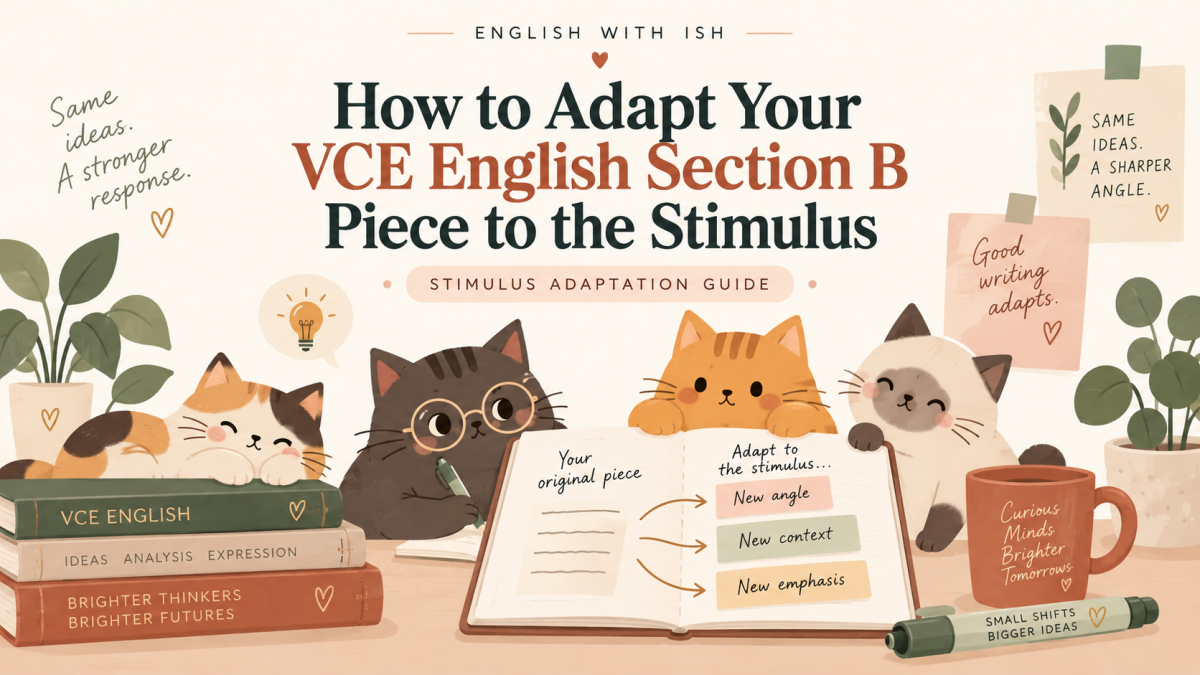
To adapt a prepared VCE English Section B piece, keep its strongest voice, setting and central conflict, but rebuild its meaning around the unseen title and at least one stimulus. Copy the exact title, decide what it means for your Framework, then change the opening, turning point and ending so that idea shapes the whole piece. Use the stimulus as a motif, argument, image or structural device, don't just mention it tokenistically. Both current VCAA reports warn us against forcing a prepared response onto the task.
I still recommend preparing a skeleton piece before the exam, but be prepared to adapt it to better fit the title and stimulus.
Section B tests whether you can make deliberate writing decisions in response to material you have not seen before. A piece can be polished, moving and technically impressive, yet remain capped by a weak connection to the task.
The 2026 VCE English examination is scheduled for Tuesday 27 October from 9.00 am to 12.15 pm. That session includes 15 minutes of reading time and three hours of writing. Section B is worth 20 of the examination’s 60 marks, so learning to adapt properly is worth far more than memorising another page of decorative description.
What Section B actually requires
You must create one written prose text connected to one of the four Frameworks of Ideas: country, protest, personal journeys or play. You must use the title assigned to that Framework and ideas drawn from at least one of its three unseen stimuli. Your piece needs a clear purpose—to explain, express, reflect or argue—and it can pursue more than one. It also needs an appropriate voice, cohesive structure and purposeful language.
The response cannot be a song, poem or verse. That does not ban lyrical prose, fragmented narration or experimentation. It means the submitted work must still function as a prose text.
You are not required to name or quote your mentor texts. Their job is to teach you how good writing works, not to become references you squeeze into the examination. VCAA does not prefer a particular prose form, style or content. A speech is not automatically safer than a short story; a personal reflection is not automatically more authentic than an imagined monologue. The form earns its place when it suits the purpose, voice, audience and idea.
The exam answer book asks you to nominate your Framework and stimulus. The 2025 report also notes that it helps the assessor if you write the supplied title at the start. Do that. Copy it exactly. The title is fixed, and titles cannot be mixed between Frameworks.
Preparing a Skeleton Essay
A useful skeleton essay gives you material you know well enough to reshape under pressure.
Its stable elements might include:
-
a convincing narrative voice
-
a setting or relationship you can render precisely
-
a central tension with room for different interpretations
-
two or three structural turns
-
a small bank of recurring images or language patterns
-
a clear sense of the Framework ideas the piece can explore.
Treat these as the bones. The examination title and stimulus decide how they are assembled.
The adaptable elements should include the opening image, the narrator’s realisation, the emphasis of each scene, the controlling motif and the final implication. Sometimes the audience, form or dominant purpose will also need to change. If your story survives every imaginable title with only one new sentence, it is not adaptable. It is generic.
VCAA’s 2024 and 2025 reports use almost identical language when describing a common limitation: students contorted prepared responses to make them appear connected to the title and stimulus. That is a useful warning. The problem is not preparation. The problem is refusing to let the task alter the prepared material.
Let the title change the meaning
Students often “use” the title by copying it above the piece, repeating it in the opening and dropping it into the final line.
In the 2025 paper, the four titles were Origins, Small Acts, Big Wins, Changing Direction and Life is a Game. Each could support several interpretations. Origins might concern ancestry, place, language, ownership, reinvention or the unreliability of beginnings. Changing Direction could describe deliberate transformation, forced disruption, retreat, moral redirection or the recognition that progress is not linear.
Before planning your response, finish this sentence:
In this piece, the title means…
Then make it less obvious. If your first answer to Life is a Game is simply “life has winners and losers”, ask what the rules hide, who writes them, why people consent to them or what happens when somebody refuses the score. The higher expected qualities reward insightful consideration of ideas raised by the title and stimulus. Insight begins when the title becomes a problem to explore rather than a slogan to repeat.
Your definition does not need to remain fixed. A strong piece may allow the title to change meaning. What begins as a promise might become a threat. A victory might expose a loss. A journey that appears to change direction may reveal that the traveller has finally returned to an earlier self.
That shift gives the piece shape.
Use the stimulus to shape your thinking around the title
The exam asks for meaningful connections with ideas drawn from at least one stimulus. You do not need to quote a written stimulus word for word, describe a visual stimulus literally or stop the piece to explain the connection.
A stimulus can influence:
-
the central idea you test
-
a recurring image or object
-
the relationship between two characters
-
the structure of the piece
-
the audience being addressed
-
an argument the narrator accepts, complicates or rejects.
The 2024 report praises responses that revisited imagery from a stimulus to build cohesion. The 2025 report similarly highlights stimulus material being joined to language choices that amplified ideas. Both reports criticise literal use with no deeper connection—for example, placing characters in a game simply because the visual showed one, while doing little with the Framework or title.
A quick test is to remove the obvious stimulus reference. If nothing meaningful changes, the connection is probably decorative. If removing it damages the logic, imagery or development of the piece, the stimulus is doing real work.
Adapting our piece to the title and stimulus
You will not have unlimited planning time, and Section B is only one of three equally weighted sections. My practical recommendation is to spend about 5 minutes deciding how your material will change the piece before you begin writing.
Write the exact title above the response and nominate the correct Framework and stimulus. Choose the stimulus that gives your existing material the most interesting new tension, not necessarily the one that looks easiest to insert.
Write the task meaning in one sentence
Complete: “Through this piece, I will [express/reflect/explain/argue] that…”
Include the title’s idea and the stimulus connection in that sentence. If you cannot, you are not ready to draft.
Mark three points of change
Write one note beside each:
Opening: How will the title or stimulus enter the piece’s world?
Turn: What discovery, conflict or contradiction will complicate it?
Ending: What will the reader now understand differently?
These are the parts most likely to need rewriting. A new ending is particularly important because it determines the significance of everything before it.
Choose one repeated thread
Select an image, phrase, object, sound or structural pattern that can recur with changed meaning. It might be a whistle, map, scar, family recipe, locked gate, unfinished game or mistranslated word. Use it sparingly. Repetition creates cohesion only when the meaning develops.
A worked example: adapting a piece about play
Suppose you have prepared a first-person reflective piece about an athlete whose identity is built around winning. Your stable material includes a precise voice, the physical ritual before competition and a final encounter with a younger athlete.
Now imagine the title is Life is a Game, with a stimulus that raises questions about following rules while others succeed by breaking them.
The weak adaptation adds a line about life being a game, mentions unfair judging and otherwise reproduces the original piece. The stimulus has been attached, but the piece has not been rethought.
A stronger adaptation makes rules the organising tension:
-
The opening ritual presents rules as safety and fairness.
-
The narrator gradually recognises that unwritten expectations (appearance, silence, obedience) matter more than the official rule book.
-
A judging decision or hidden injury complicates the idea that effort produces a fair score.
-
The younger athlete asks a question that the narrator once refused to ask.
-
The ending rejects, rewrites or deliberately continues the game’s conditions.
The same voice and much of the same world can remain. What changes is the reason those details matter. The title now shapes the conceptual argument, while the stimulus informs the recurring language of rules, scores and cheating. The piece has adapted because its meaning and movement would be different under another task.
This is what a skeleton is for. You are not starting again; you are giving familiar material a new nervous system.
Purpose, voice and form need to agree
After adapting the idea, check that the writing choices still fit.
If the main purpose is to reflect, the voice should demonstrate changed understanding rather than merely recount events. If the purpose is to argue, the text needs a position, a reader to influence and a structure that develops reasons. If it aims to explain, cause, consequence and connection must become clear. If it aims to express, the language should communicate an experience or idea with deliberate force rather than becoming a diary entry written only for the self.
Purpose can also overlap. A eulogy may express grief while arguing for a community to remember differently. A memoir extract may reflect on migration while explaining the politics of language. The useful question is not “which box does my piece fit?” but “what am I trying to make this particular reader think, feel or reconsider?”
Voice is how that purpose reaches the reader. It includes vocabulary, rhythm, sentence structure, register, selection of detail and what the speaker withholds. A teenage speaker, local councillor and grieving parent should not sound interchangeable. Nor should a speech, opinion column and private letter use the same relationship with the audience.
Form is not a costume. Headings, diary dates, transcript labels, footnotes and page divisions only help when they create meaning. A letter needs a reason to be addressed. A speech needs an audience whose presence affects the language. A fragmented structure needs a purpose beyond looking literary.
What strong adaptation leaves alone
Do not panic and replace everything. Under time pressure, unnecessary reinvention produces flat writing.
Keep the elements you can execute reliably: the voice you understand, the setting you can render, the syntax you control and the images you know how to develop. Keep any scene that now proves the title-focused idea. Keep the emotional restraint and precise observation that made the original effective.
What you should abandon is material that only survives because you memorised it. A beautiful paragraph that drags the piece away from the task is expensive. So is an elaborate ending that resolves the old version rather than the examination version.
The 2025 report notes that assessors judge three interconnected things: the quality of the Framework ideas connected to the title and stimulus; the use of voice to develop those ideas and achieve purpose; and the language and structures used to communicate them. Clever phrasing cannot rescue irrelevant thinking because the language is assessed through the task it is meant to perform.
How to practise adaptation before October
Do not prepare five completely different pieces. Build one or two flexible skeletons and make them answer different tasks.
Three times a week, give yourself a new title and three stimuli. Spend 12 minutes producing only a plan. Rewrite the one-sentence purpose, the opening, the central turn and the ending. Then compare the plan with the previous version. If 90 per cent is unchanged, force a stronger conceptual change.
Once a week, write the full piece by hand under timed conditions. Afterwards, use three colours:
-
one for the title’s idea
-
one for the stimulus connection
-
one for choices that establish voice and purpose.
Sparse title or stimulus colour means weak adaptation. Plenty of both colours concentrated only in the first and final paragraphs usually means the connection has been bolted on. The best responses distribute the task through the piece without repeating it mechanically.
Ask another person to read the response without showing them the task. Can they infer the title’s central idea, the relevant Framework and the stimulus concept? If they can only identify your pre-prepared story, revise.
The final check
Before moving to another section, ask:
-
Have I copied the exact title and selected the matching Framework?
-
Is at least one stimulus meaningfully shaping the writing?
-
Does the piece explore a Framework idea rather than merely mention the topic?
-
Is the purpose clear from what the text does?
-
Is the voice appropriate for a specific audience and context?
-
Do the structure and language develop the idea rather than decorate it?
The best preparation is not memorisation and it is not improvisation. It is controlled flexibility. Know your material well enough to change it, and understand your Framework deeply enough that an unseen title can open a new route through it.
For a complete plan across all three sections, use my 2026 VCE English exam study guide. You can also browse the English with Ish resources or view the current VCE English tutoring options.
If you bring your skeleton piece and one unseen task to a lesson, we can test the adaptation rather than merely polish the memorised version.